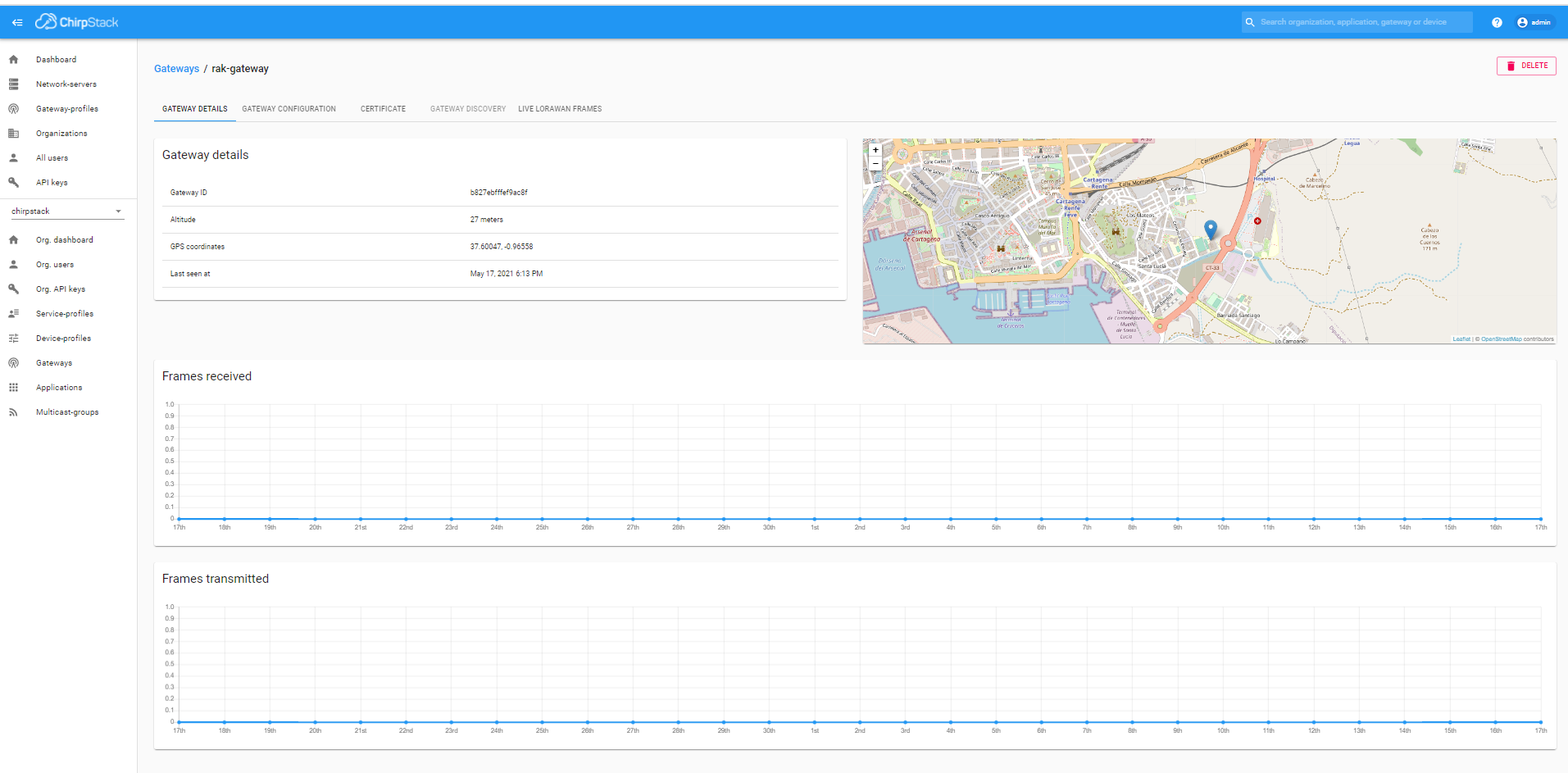
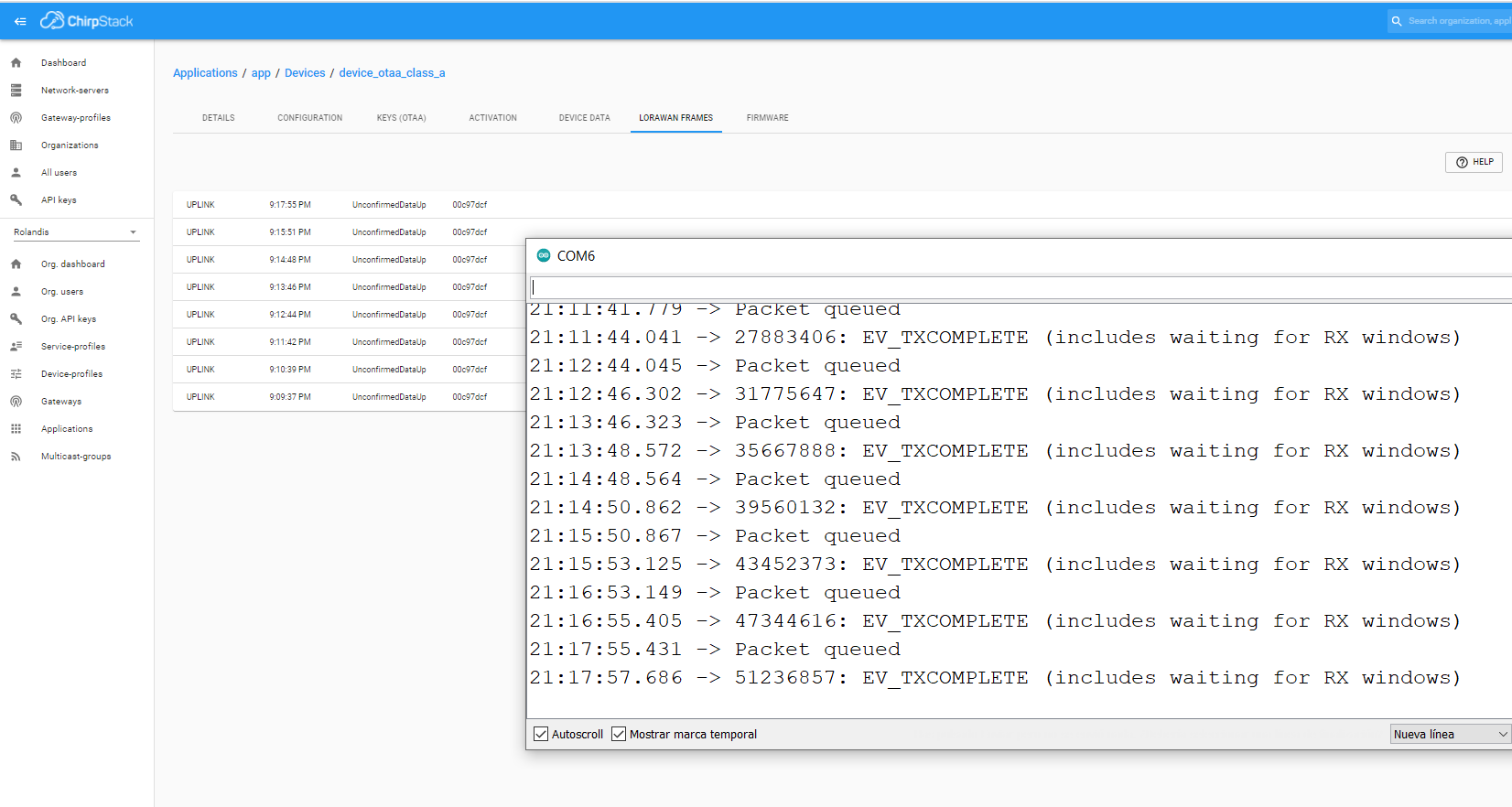
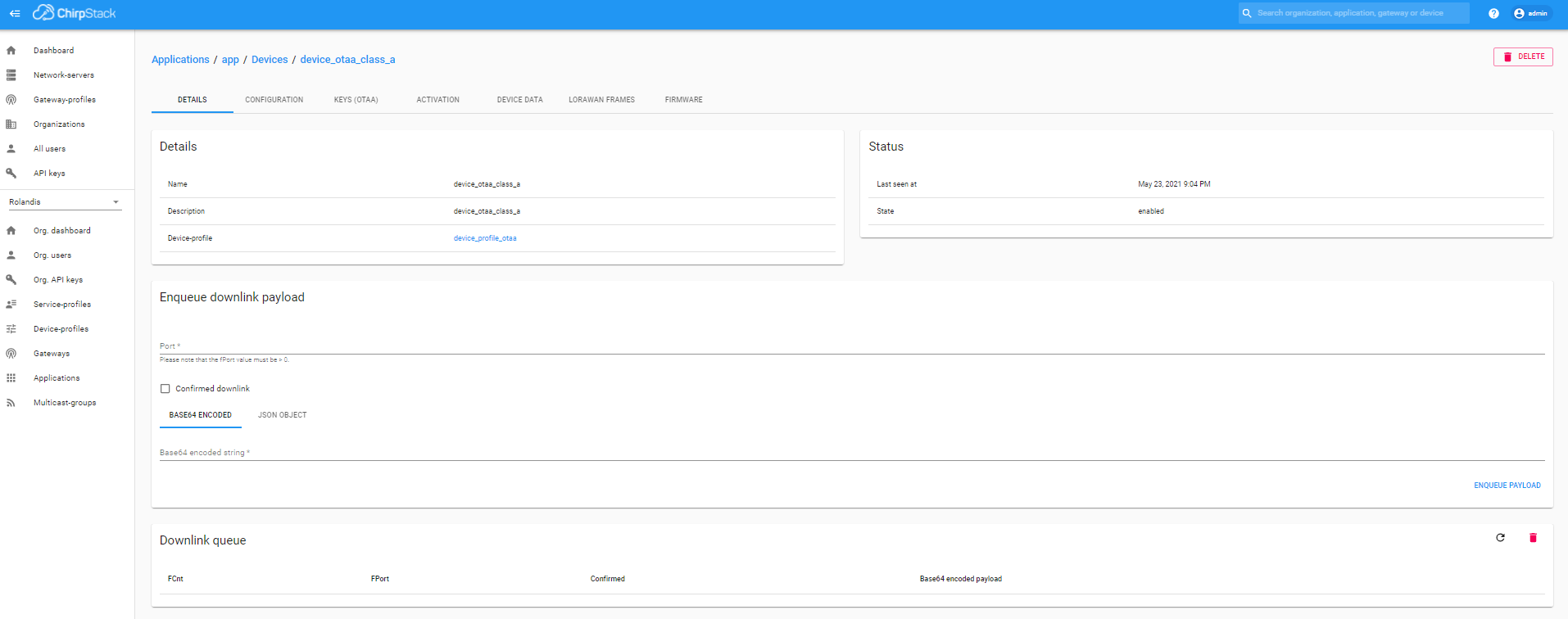
I have used IBM LMIC ttn otaa library renamed on behalf of my first contact:
/*******************************************************************************
-
Copyright (c) 2015 Thomas Telkamp and Matthijs Kooijman
-
-
Permission is hereby granted, free of charge, to anyone
-
obtaining a copy of this document and accompanying files,
-
to do whatever they want with them without any restriction,
-
including, but not limited to, copying, modification and redistribution.
-
NO WARRANTY OF ANY KIND IS PROVIDED.
-
-
This example sends a valid LoRaWAN packet with payload "Hello,
-
world!", using frequency and encryption settings matching those of
-
the The Things Network.
-
-
This uses OTAA (Over-the-air activation), where where a DevEUI and
-
application key is configured, which are used in an over-the-air
-
activation procedure where a DevAddr and session keys are
-
assigned/generated for use with all further communication.
-
-
Note: LoRaWAN per sub-band duty-cycle limitation is enforced (1% in
-
g1, 0.1% in g2), but not the TTN fair usage policy (which is probably
-
violated by this sketch when left running for longer)!
-
To use this sketch, first register your application and device with
-
the things network, to set or generate an AppEUI, DevEUI and AppKey.
-
Multiple devices can use the same AppEUI, but each device has its own
-
DevEUI and AppKey.
-
-
Do not forget to define the radio type correctly in config.h.
-
*******************************************************************************/
#include <lmic.h>
#include <hal/hal.h>
#include <SPI.h>
// This EUI must be in little-endian format, so least-significant-byte
// first. When copying an EUI from ttnctl output, this means to reverse
// the bytes. For TTN issued EUIs the last bytes should be 0xD5, 0xB3,
// 0x70.
static const u1_t PROGMEM APPEUI[8]={ 0x00, 0x00, 0x00, 0x00, 0x00, 0x00, 0x00, 0x00 };
void os_getArtEui (u1_t* buf) { memcpy_P(buf, APPEUI, 8);}
// This should also be in little endian format, see above.
static const u1_t PROGMEM DEVEUI[8]={ 0x5b, 0xb1, 0x7b, 0x37, 0xe7, 0x5e, 0xc1, 0x4b };
void os_getDevEui (u1_t* buf) { memcpy_P(buf, DEVEUI, 8);}
// This key should be in big endian format (or, since it is not really a
// number but a block of memory, endianness does not really apply). In
// practice, a key taken from ttnctl can be copied as-is.
// The key shown here is the semtech default key.
static const u1_t PROGMEM APPKEY[16] = { 0x2c, 0x2f, 0x6f, 0x96, 0x9d, 0xee, 0xc6, 0x84, 0x05, 0x1a, 0x8e, 0xf0, 0x76, 0x3e, 0x77, 0xa4 };
void os_getDevKey (u1_t* buf) { memcpy_P(buf, APPKEY, 16);}
static uint8_t mydata[] = “Hello, world!”;
static osjob_t sendjob;
// Schedule TX every this many seconds (might become longer due to duty
// cycle limitations).
const unsigned TX_INTERVAL = 60;
// Pin mapping
const lmic_pinmap lmic_pins = {
.nss = 18,
.rxtx = LMIC_UNUSED_PIN,
.rst = 23,
.dio = {26, 33, 32},
/// .dio = {2, 3, 4},
};
void onEvent (ev_t ev) {
Serial.print(os_getTime());
Serial.print(": ");
switch(ev) {
case EV_SCAN_TIMEOUT:
Serial.println(F(“EV_SCAN_TIMEOUT”));
break;
case EV_BEACON_FOUND:
Serial.println(F(“EV_BEACON_FOUND”));
break;
case EV_BEACON_MISSED:
Serial.println(F(“EV_BEACON_MISSED”));
break;
case EV_BEACON_TRACKED:
Serial.println(F(“EV_BEACON_TRACKED”));
break;
case EV_JOINING:
Serial.println(F(“EV_JOINING”));
break;
case EV_JOINED:
Serial.println(F(“EV_JOINED”));
        // Disable link check validation (automatically enabled
        // during join, but not supported by TTN at this time).
        LMIC_setLinkCheckMode(0);
        break;
    case EV_RFU1:
        Serial.println(F("EV_RFU1"));
        break;
    case EV_JOIN_FAILED:
        Serial.println(F("EV_JOIN_FAILED"));
        break;
    case EV_REJOIN_FAILED:
        Serial.println(F("EV_REJOIN_FAILED"));
        break;
        break;
    case EV_TXCOMPLETE:
        Serial.println(F("EV_TXCOMPLETE (includes waiting for RX windows)"));
        if (LMIC.txrxFlags & TXRX_ACK)
          Serial.println(F("Received ack"));
        if (LMIC.dataLen) {
          Serial.println(F("Received "));
          Serial.println(LMIC.dataLen);
          Serial.println(F(" bytes of payload"));
        }
        // Schedule next transmission
        os_setTimedCallback(&sendjob, os_getTime()+sec2osticks(TX_INTERVAL), do_send);
        break;
    case EV_LOST_TSYNC:
        Serial.println(F("EV_LOST_TSYNC"));
        break;
    case EV_RESET:
        Serial.println(F("EV_RESET"));
        break;
    case EV_RXCOMPLETE:
        // data received in ping slot
        Serial.println(F("EV_RXCOMPLETE"));
        break;
    case EV_LINK_DEAD:
        Serial.println(F("EV_LINK_DEAD"));
        break;
    case EV_LINK_ALIVE:
        Serial.println(F("EV_LINK_ALIVE"));
        break;
     default:
        Serial.println(F("Unknown event"));
        break;
}
}
void do_send(osjob_t* j){
// Check if there is not a current TX/RX job running
if (LMIC.opmode & OP_TXRXPEND) {
Serial.println(F(“OP_TXRXPEND, not sending”));
} else {
// Prepare upstream data transmission at the next possible time.
LMIC_setTxData2(1, mydata, sizeof(mydata)-1, 0);
Serial.println(F(“Packet queued”));
}
// Next TX is scheduled after TX_COMPLETE event.
}
void setup() {
Serial.begin(115200);
Serial.println(F(“Starting”));
#ifdef VCC_ENABLE
// For Pinoccio Scout boards
pinMode(VCC_ENABLE, OUTPUT);
digitalWrite(VCC_ENABLE, HIGH);
delay(1000);
#endif

// LMIC init
os_init();
// Reset the MAC state. Session and pending data transfers will be discarded.
LMIC_reset();

// Start job (sending automatically starts OTAA too)
do_send(&sendjob);
}
void loop() {
os_runloop_once();
}
I suspect there could still be a pin assignation problem, or a problem in my void Enqueue dowlink payload config: