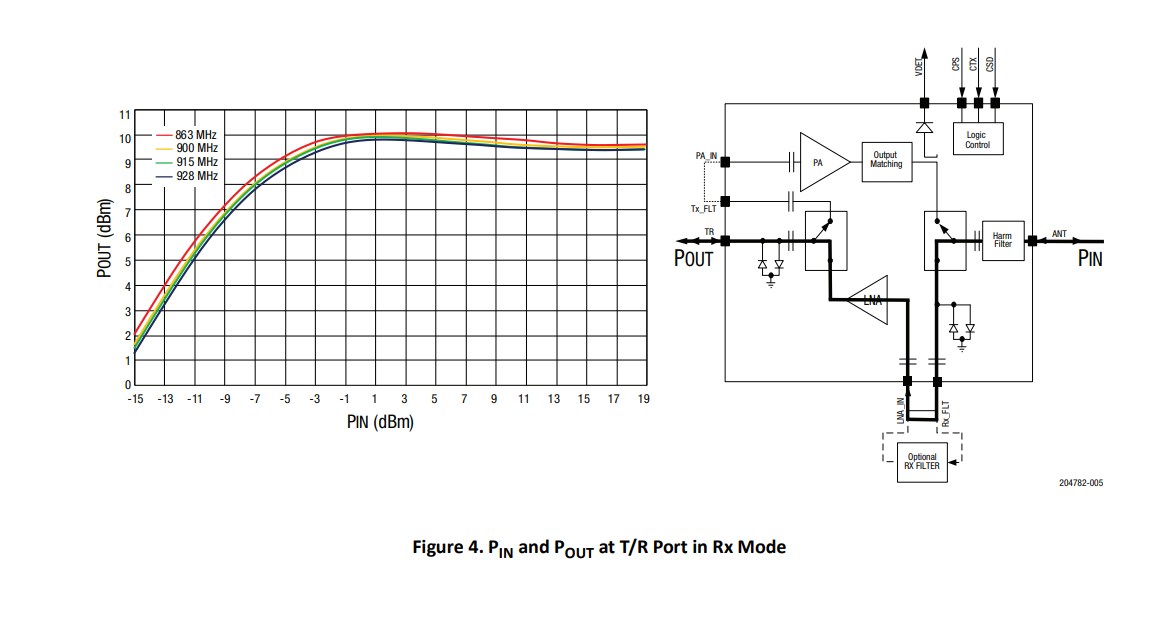
Looking the Skyworks FEM in the RAK13302, I see they have clamp diodes at the output of the LNA. The LNA is specified at 16dB gain, and the Qualcomm SAW RX filter is a little more than 2dB insertion loss. So this suggests the RAK13302 LNA will become non-linear with more than about -6 dBm total input in the 902-928 MHz band. With multiple signals in the 902-928MHz band, this will create intermodulation all across the band.
For end-node use, this seems like it probably isn’t a factor, but use at a high-RF radio site or near another transmitter in the 902-928MHz band, this is surely going to overload and reduce receiver sensitivity.
Hi Dana,
I am not an RF expert, so I asked our R&D team.
Based on the SKY66122 specifications (LNA IP1dB is -10 dBm), when the total in-band input power approaches -6 dBm, it will indeed push the LNA into its non-linear operating region, causing intermodulation distortion.
It is important to note that the RAK13302 is primarily designed for end-node applications. In typical end-node scenarios, the device is usually far from the gateway, and the received target signal is extremely weak (typically between -120 dBm and -60 dBm). Therefore, in standard end-node deployments, strong in-band interference at the -6 dBm level is rarely encountered, and this overloading phenomenon typically does not occur.
Of course, scenarios involving “high-RF-density environments” or “proximity to co-located high-power transmitters” do objectively exist. In these special deployments, there is indeed a risk of overloading and receiver desensitization.
From a system-level design perspective, standard industry practices to mitigate such high-interference scenarios include: adding external controllable attenuators (triggered by RSSI), increasing spatial isolation, or selecting external high-linearity LNAs and FEMs with bypass functions for gateway-level equipment.
Thank you Bernd! I suspected the 13302 is intended for end-node applications and appreciate the direct statement from the R&D team.
The challenge is that mesh nodes are being placed at high-level radio sites where there is a high level of in-band interference, or co-located with other mesh nodes (such as Meshtastic to Meshcore gateways).