hello,
I have a very simple setup: a RAK4630 on a RAK19007 baseboard with a RAK1901 temperature sensor (SHTC3) powered by two AA batteries connected in parallel.
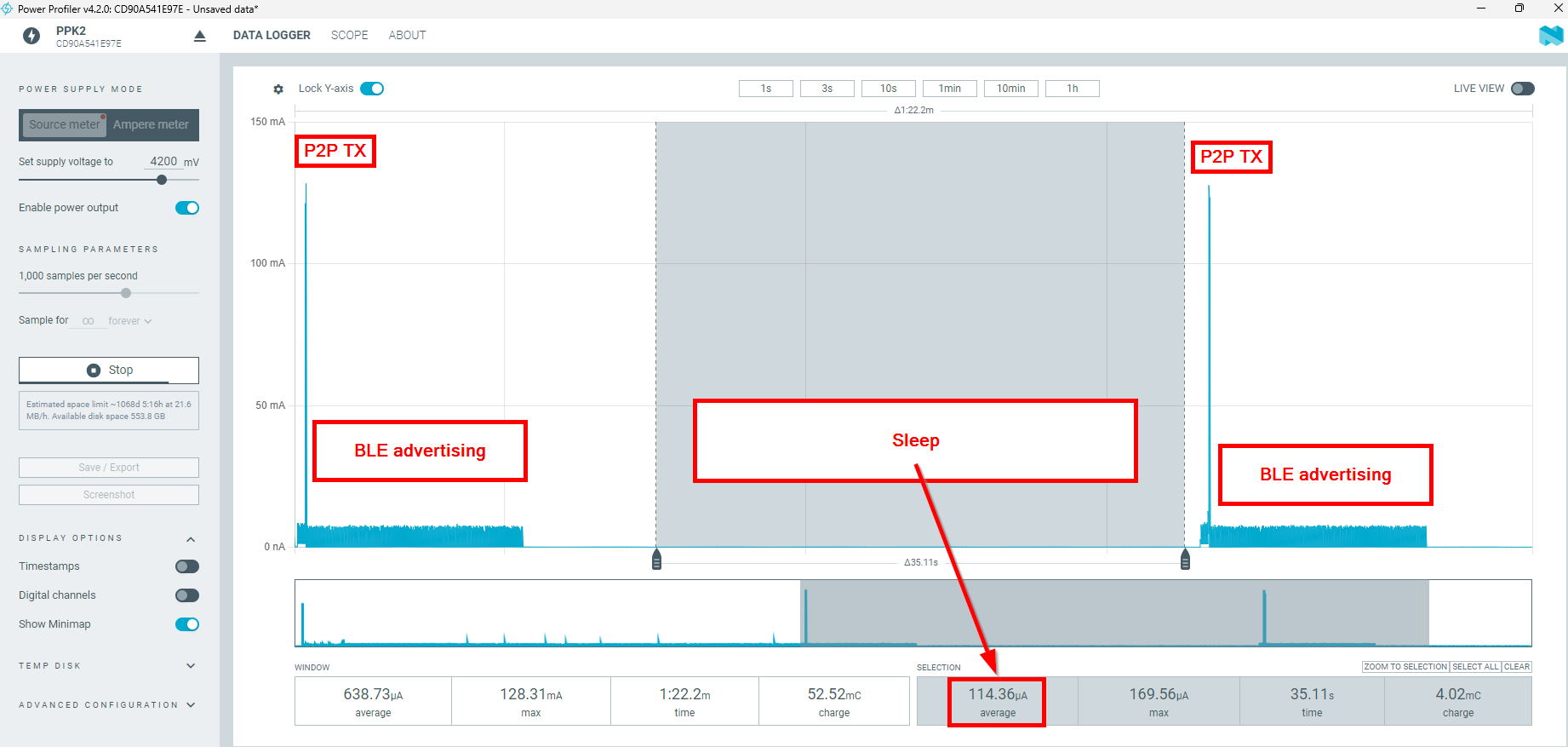
I send temperature, humidity, and voltage data every 30 minutes (for the tests i put 3 minutes), then switch to sleep mode. However, the standby current is 600µA, whereas I expected a maximum of 10µA. Is there a hardware limitation or a software trick to achieve this?
#include <Arduino.h>
#include <SX126x-RAK4630.h>
#include <SPI.h>
#include <Wire.h>
#include "SparkFun_SHTC3.h"

#define SLEEP_TIME 180000
#define RF_FREQUENCY 868300000
#define TX_OUTPUT_POWER 22

typedef struct {
    int16_t temp;
    uint16_t hum;
    uint16_t batt;
} Payload;

SHTC3 g_shtc3;
static RadioEvents_t RadioEvents;
SoftwareTimer taskWakeup;

float read_battery() {
    analogReference(AR_INTERNAL_3_0);
    analogReadResolution(12);
    delay(2);
    return (float)analogRead(WB_A0) * (3000.0 / 4095.0) * 1.73;
}

void perform_measure_and_send() {
    digitalWrite(WB_IO2, HIGH);
    delay(15);

    Wire.begin();
    if(g_shtc3.begin() == SHTC3_Status_Nominal) {
        g_shtc3.wake();
        g_shtc3.update();

        Payload p;
        p.temp = (int16_t)(g_shtc3.toDegC() * 100);
        p.hum = (uint16_t)(g_shtc3.toPercent() * 100);
        p.batt = (uint16_t)read_battery();

        g_shtc3.sleep();
        Radio.Send((uint8_t *)&p, sizeof(p));
    }

    Wire.end();
    pinMode(PIN_WIRE_SDA, INPUT);
    pinMode(PIN_WIRE_SCL, INPUT);
    digitalWrite(WB_IO2, LOW);
}

void setup() {
    // 1. Coupure totale UART et activation DCDC
    NRF_POWER->DCDCEN = 1;
    NRF_UART0->ENABLE = 0;

    // 2. Extinction LEDs
    pinMode(LED_BLUE, OUTPUT); digitalWrite(LED_BLUE, LOW);
    pinMode(LED_GREEN, OUTPUT); digitalWrite(LED_GREEN, LOW);

    // 3. Alimentation Slots
    pinMode(WB_IO2, OUTPUT);
    digitalWrite(WB_IO2, LOW);

    // 4. Radio
    lora_rak4630_init();
    RadioEvents.TxDone = [] { Radio.Sleep(); };
    RadioEvents.TxTimeout = [] { Radio.Sleep(); };
    Radio.Init(&RadioEvents);
    Radio.SetChannel(RF_FREQUENCY);
    Radio.SetTxConfig(MODEM_LORA, TX_OUTPUT_POWER, 0, 0, 7, 1, 8, false, true, 0, 0, false, 3000);
    Radio.Sleep();

    // 5. Timer & Sommeil
    taskWakeup.begin(SLEEP_TIME, [](TimerHandle_t xTimer) { perform_measure_and_send(); });
    taskWakeup.start();

    perform_measure_and_send();
    suspendLoop();
}

void loop() {}