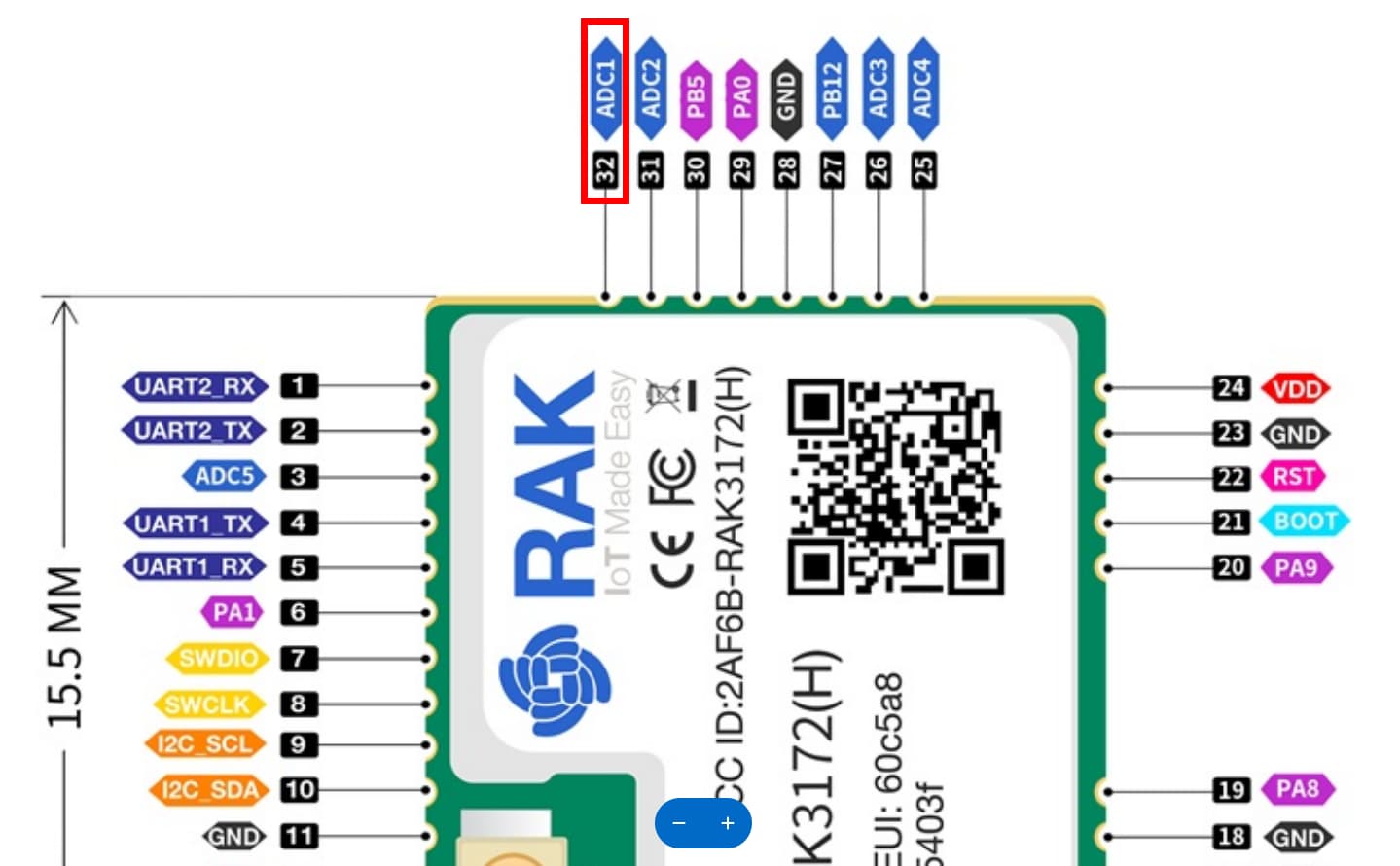
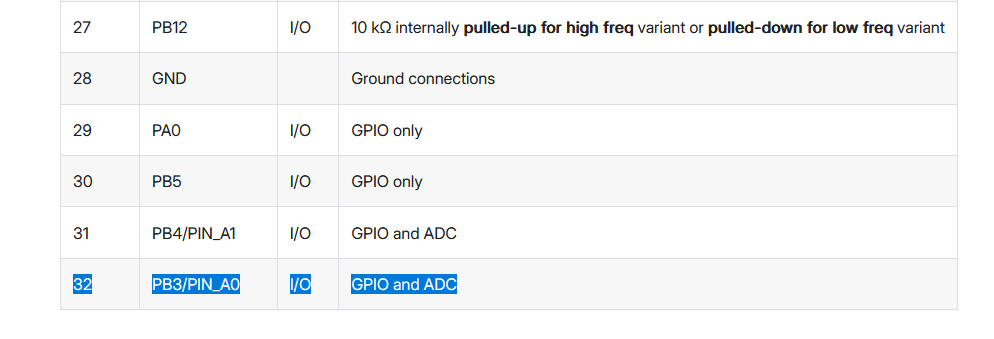
@beegee I wrote a test program which seems to indicate at least PIN32 does not wake the RAK3172 from sleep.all(). I tested with a PIR (monitoring the Pin value with a meter as well). Here is the program and section of serial monitor listing of my testing. It seems like only the sleep timer calls the registerWakeCallback routine. I have not attempted yet with AT commands instead of RUI API.
// -------------------------------------------------------------
// RAK3172 (RUI3 v4.2.1+) PIR Wake Test with GPIO-Verified Wake Reason
// - Logs PIR state before sleep and after wake
// - 5s awake, 10s sleep
// - PB3 (Pin 32) = PIR digital input, rising-edge wake
// - PA9 (Pin 20) = LED output, LOW = ON, HIGH = OFF
// -------------------------------------------------------------
#include “Arduino.h”
// -------------------------------------------------------------
// Pin definitions
// -------------------------------------------------------------
#define PIR_PIN PB3 // Arduino-style pin for pinMode(), digitalRead()
#define PIR_PIN_GPIO 32 // RUI3 GPIO number for sleep.setup()
#define LED_PIN PA9 // Pin 20 (LED output)
// -------------------------------------------------------------
// Wake reason flag (set ONLY by callback, for visibility)
// -------------------------------------------------------------
volatile bool pirWakeFlag = false;
// Forward declaration
void pirWakeupCallback(void);
void setup() {
Serial.begin(115200);
delay(200);
Serial.println("\n--- RAK3172 PIR Wake Test (PIR State Before/After Sleep) ---");

// LED output
pinMode(LED_PIN, OUTPUT);
digitalWrite(LED_PIN, LOW);   // LED ON when awake

// PIR input (hardware debounce)
pinMode(PIR_PIN, INPUT);

// Configure wakeup source (requires numeric GPIO ID)
api.system.sleep.setup(RUI_WAKEUP_RISING_EDGE, PIR_PIN_GPIO);

// Register callback
api.system.sleep.registerWakeupCallback(pirWakeupCallback);

Serial.println("Setup complete. Waiting for PIR or sleep cycle...");
}
void loop() {
// Indicate awake
digitalWrite(LED_PIN, LOW); // LED ON
Serial.println(“Awake. Running for 5 seconds…”);
delay(5000);
// Clear wake flag before sleeping (for logging clarity)
pirWakeFlag = false;

// ---------------------------------------------------------
// Log PIR state BEFORE sleep
// ---------------------------------------------------------
bool pirBefore = digitalRead(PIR_PIN);
Serial.print("PIR state BEFORE sleep: ");
Serial.println(pirBefore ? "HIGH" : "LOW");

// Prepare to sleep
Serial.println("Going to sleep for 10000 ms unless PIR triggers...");
digitalWrite(LED_PIN, HIGH);  // LED OFF just before sleep

// Enter low-power sleep (LPMLVL=2 supported)
api.system.sleep.all(10000);

// Execution resumes here after timeout OR PIR wake
digitalWrite(LED_PIN, LOW);   // LED ON immediately after wake

// ---------------------------------------------------------
// Log PIR state AFTER wake
// ---------------------------------------------------------
bool pirAfter = digitalRead(PIR_PIN);
Serial.print("PIR state AFTER wake: ");
Serial.println(pirAfter ? "HIGH" : "LOW");

// ---------------------------------------------------------
// GPIO-verified wake reason
// ---------------------------------------------------------
if (pirAfter == HIGH) {
    Serial.println("WAKE REASON: PIR (PB3 is HIGH after wake)");
} else {
    Serial.println("WAKE REASON: TIMEOUT (PB3 is LOW after wake)");
}
}
// -------------------------------------------------------------
// PIR wake callback
// -------------------------------------------------------------
void pirWakeupCallback(void) {
pirWakeFlag = true; // Mark that RUI3 thinks PIR caused the wake
Serial.println(“>>> PIR WAKEUP CALLBACK TRIGGERED <<<”);
}
Serial Monitor: (see time stamp starting at 11:29:34.762), PIR active during sleep failed to awaken sleep timer.
11:29:14.685 →
11:29:14.685 → — RAK3172 PIR Wake Test (PIR State Before/After Sleep) —
11:29:14.722 → Setup complete. Waiting for PIR or sleep cycle…
11:29:14.722 → Current Work Mode: LoRaWAN.
11:29:14.722 → Awake. Running for 5 seconds…
11:29:19.738 → PIR state BEFORE sleep: LOW
11:29:19.738 → Going to sleep for 10000 ms unless PIR triggers…
11:29:29.705 → >>> PIR WAKEUP CALLBACK TRIGGERED <<<
11:29:29.748 → PIR state AFTER wake: LOW
11:29:29.748 → WAKE REASON: TIMEOUT (PB3 is LOW after wake)
11:29:29.748 → Awake. Running for 5 seconds…
11:29:34.762 → PIR state BEFORE sleep: LOW
11:29:34.762 → Going to sleep for 10000 ms unless PIR triggers…
11:29:44.730 → >>> PIR WAKEUP CALLBACK TRIGGERED <<<
11:29:44.730 → PIR state AFTER wake: HIGH
11:29:44.730 → WAKE REASON: PIR (PB3 is HIGH after wake)
11:29:44.776 → Awake. Running for 5 seconds…
11:29:49.771 → PIR state BEFORE sleep: HIGH
11:29:49.771 → Going to sleep for 10000 ms unless PIR triggers…
11:29:59.742 → >>> PIR WAKEUP CALLBACK TRIGGERED <<<
11:29:59.778 → PIR state AFTER wake: LOW
11:29:59.778 → WAKE REASON: TIMEOUT (PB3 is LOW after wake)
11:29:59.778 → Awake. Running for 5 seconds…