we replaced the RAK3172-SiP HP variant for the RAK3172-LP-SIP in order to save on our energy budget.
As we are in EU868, we cannot make use of the additional power of the HP variant anyways, we thought.
Now, when we hat the first samples deployed, we had to realise that signal strength is way worse than with the HP variant, making it unusable for most locations.
A lab test setup with a local gateway some rooms away showed RSSI/SNR
-84/12 for HP variant (consuming [email protected])
-105/8 for LP variant (consuming [email protected])
Thats over 20db difference…
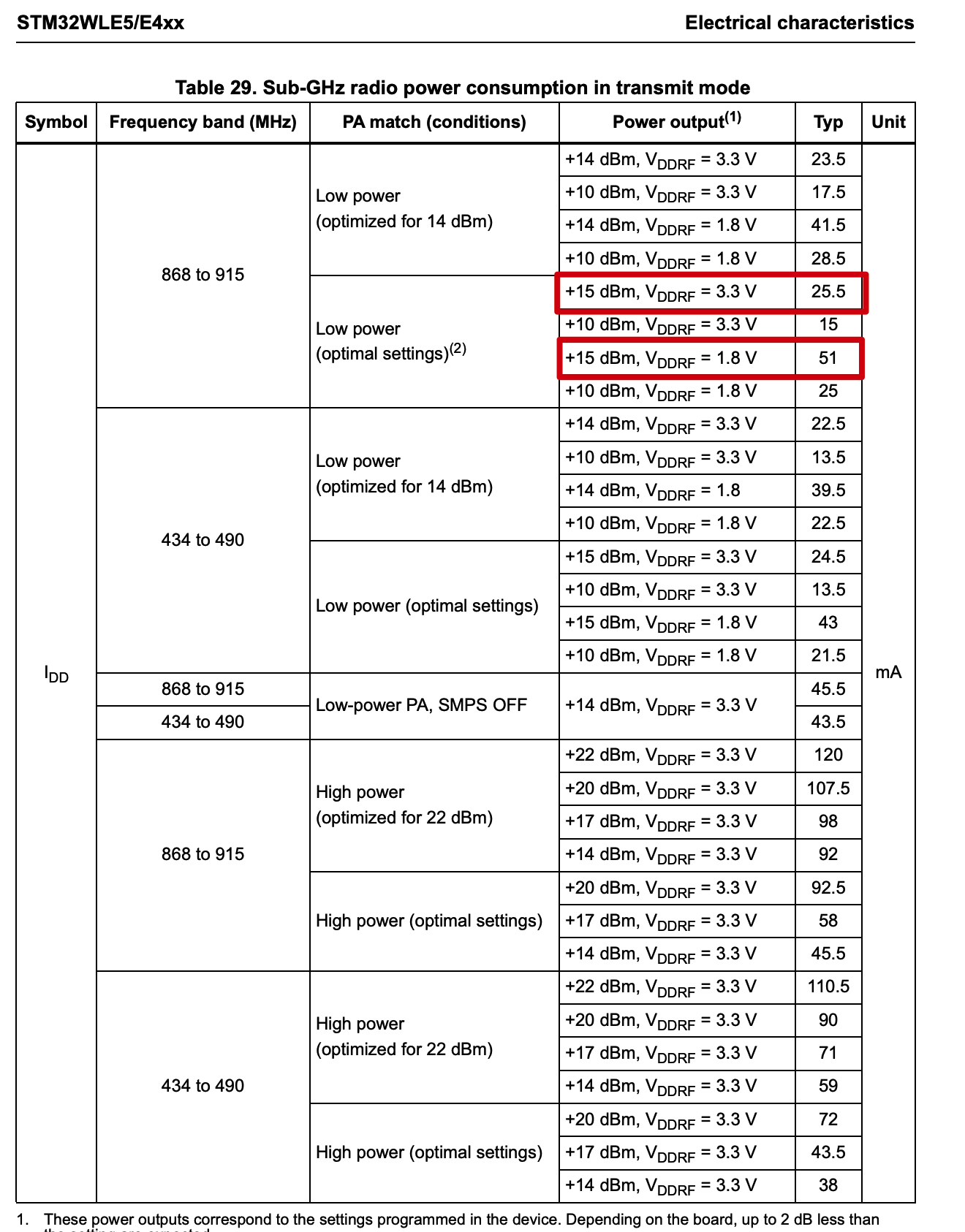
The current consumption is pretty much whats expected for optimal settings in each PA branch (Table 29 in STM32WLE5 datasheet)
Strangely current consumption goes down if I lower VDD, not the other way round (18mA @ 1.8V, but RSSI/SNR stay the same)
Of course we changed the setting in BSP_RADIO_GetTxConfig to RADIO_CONF_RFO_LP.
Is there anything else we can check?
I have to get the TX power test from our R&D team to validate.
Just to ensure we covered the basic.
Are you using the correct FW for the RAK3172-SiP and RAK3172LP-SiP? Interchanging them can have performance issues.
Are these LoRa P2P or LoRaWAN? Can you validate if the SF are the same in both case?
If you care using custom FW, did you use the provided radio files needed to be modified?
As for the current consumption when voltage are lower, I am not sure on this one too. Maybe the internal (resistive) loss are lower because of lower input voltage.
We use a custom LoRaWAN firmware based on CubeMX code, where between HP/LP versions, we only changed the value return from BSP_RADIO_GetTxConfig(void) in stm32wlxx_nucleo_radio.c from RADIO_CONF_RFO_HP to RADIO_CONF_RFO_LP.
LoRaWAN, ADR is active, starting from DR0/SF12 and going up to DR5/SF7 on both versions, but the difference in performance is persistent.
I can perform a test with ADR deactivated though.
We have modified stm32wlxx_nucleo_radio.h and stm32wlxx_nucleo_radio.c (renamed to .cpp, so it can be uploaded), see attached.
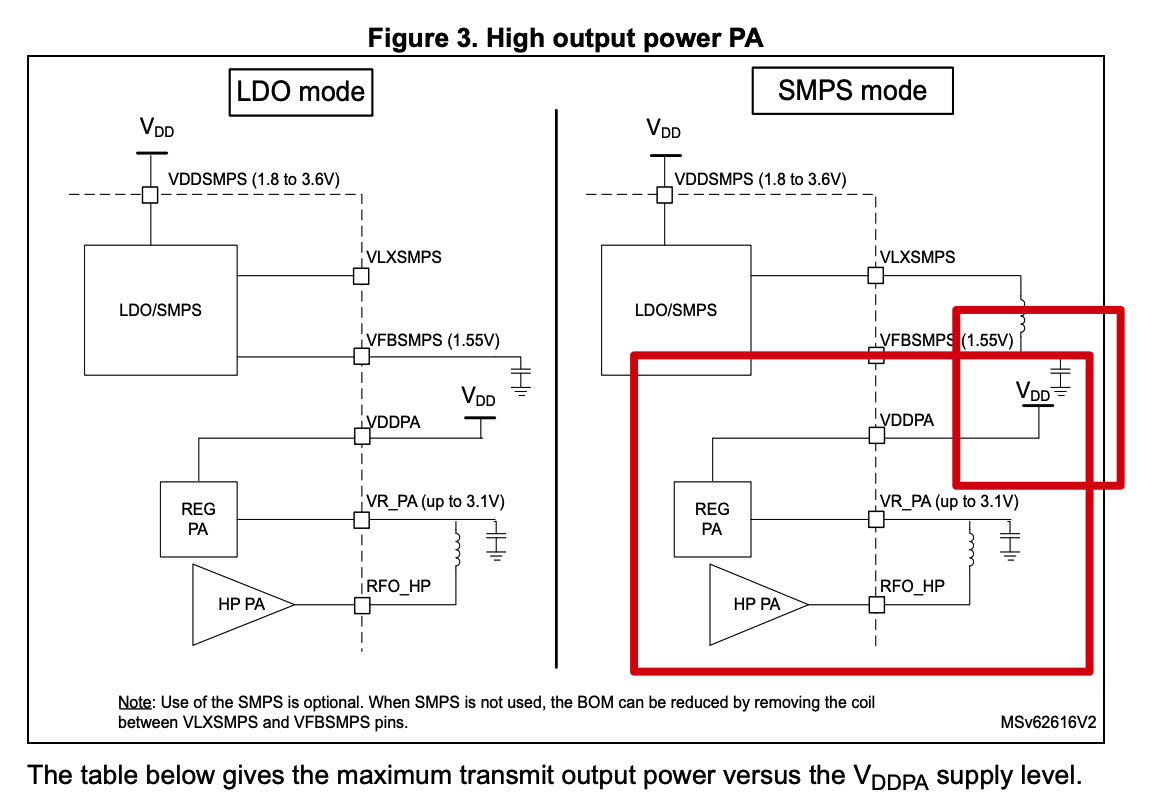
**Transmitter high output power**
Transmit high output power up to + 22 dBm, is supported through the RFO_HP RF pin.
For this, the REG PA must be supplied directly from VDD on VDDSMPS pin, as shown in the
figure below
versus
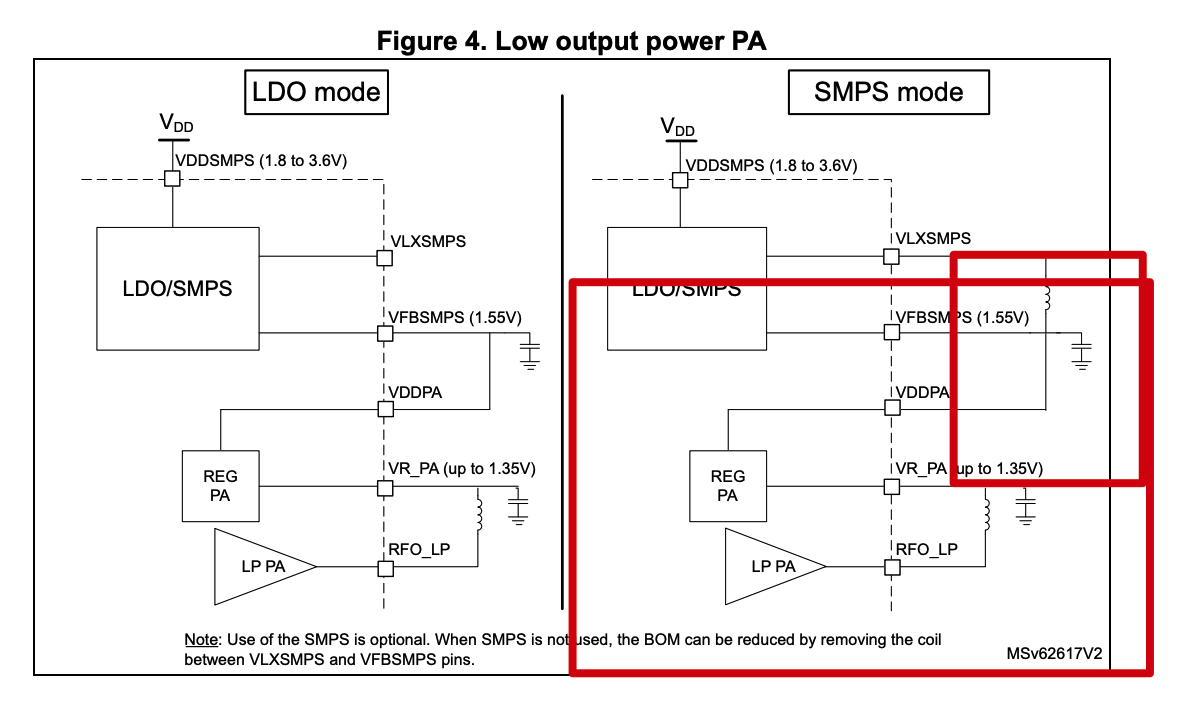
**Transmitter low output power**
The transmit low output power up to + 15 dBm on full VDD range (1.8 to 3.6 V), is supported
through the RFO_LP RF pin. For this, the REG PA must be supplied from the regulated
VFBSMPS supply at 1.55 V, as shown in the figure below
Does the VDDPA pin need to be connected differently for HP vs. LP variant?
Also to clarify: Will the LP variant be able to emit with full power when VDDPA is connected to VDD?
(In the datasheet they seem to be connected differently)
As for the VDDPA, to use the low-power output, you must connect it to VFBSMPS(1.55). I discussed about with with our hardware engineer before and he told me that it will work but with a downside of higher current. However, yours has lower which is strange.
OK, thanks a lot. I had a brief look at them and it seems I am still using the rf switch pin configuration of the RAK3172, didn’t know there was a difference to the SIP variants. Strange enough it still worked.
Will make some tests with the provided files and get back, thanks for taking the time!
With the pins set correctly, there was almost a 30dB increase compared to the LP variant with incorrect pin-settings. Great!
(The HP variant difference only showed neglectable 5db difference, which is understandable with the explanation given somewhere else that the HP variant is set to “transmit” by default in contrast to the LP variant being “off” by default)
The current draw rises up to [email protected] though, so there is no benefit in contrast to the HP variant (where I get [email protected] with ‘optimal settings’).
Is that what you were mentioning @carlrowan? Supplying VDDPA with VFBSMPS should put it to the 25mA of the datasheet?
Is that done in the breakout board as well?
I am glad you have improvement on the current consumption.
We are going to release a new Breakout Board that uses VFBSMPS pin. The current breakout board design of RAK3172LP-SiP and RAK3172-SiP has no provision for this.
As for the VDDPA, to use the low-power output, you must connect it to VFBSMPS(1.55). I discussed about with with our hardware engineer before and he told me that it will work but with a downside of higher current.
@carlrowan Thanks. Do you mean you discussed with the engineer whether it also works when VDDPA is connected to VDD instead of VFBSMPS(1.55V) and he said yes, but at the cost of higher current?