The RAK4631 has a SX1262 LoRa transceiver.
The RadioHead library does not support this transceiver and might not be compatible with the nRF52 in addition. If you need a compatible LoRa P2P library, use the SX126x-Arduino library. It supports the RAK4631 directly.
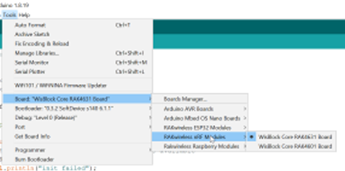
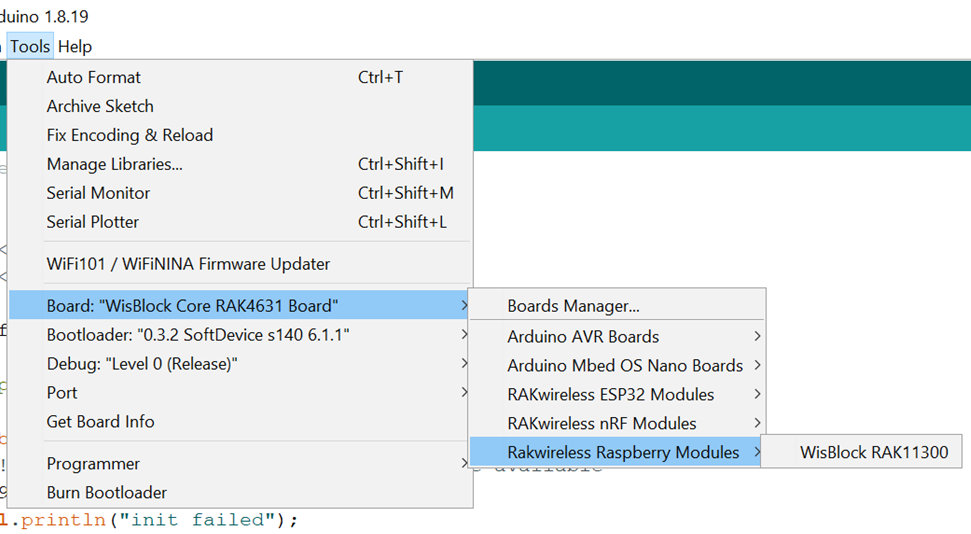
In addition it looks like you are using the RUI3 BSP instead of the Arduino BSP.
The RUI3 BSP has complete LoRa and LoRaWAN functions built-in, there is no need for external LoRa libraries. RUI3 API LoRa
If you want to use RUI3 API you have to flash a different bootloader on the RAK4631, otherwise it will not work Updating RAK4631 to RUI3
Hello Sir @beegee I’m using RAK4631 connected to RAK5005-0. Based on what I’ve read, you will use RUI3 BSP if your dealing RAK4631-R Core Board, is that right Sir? So if ever Sir, I don’t need to flash different bootloader to the one I’m currently using?
Also, this the arduino board I’m using, this is Arduino BSP Sir right?
From hardware side RAK4631 and RAK4631-R are identical.
The difference is in the bootloader and in the BSP. We have tutorials in our documentation center how to switch from Open Source BSP to RUI3:
Ohhh okayyy. That cleared up some of my questions Sir @beegee . But, is it possible to use RAK4630 or RAK4631 connected to RAK5005-O, for a multi node application? For example, I will set one of the RAK 4630/RAK4631 to be the server node who will receive and request data from several RAK4630/RAK4631 end nodes? That is what I’m trying to achieve.
RAK4630 is a stamp module that is used on the RAK4631 WisBlock Core module. That leads often to confusion, because the sticker still says RAK4630.
The difference is that the RAK4630 is to be soldered on a PCB, while the RAK4631 has a connector for the WisBlock Base Boards.
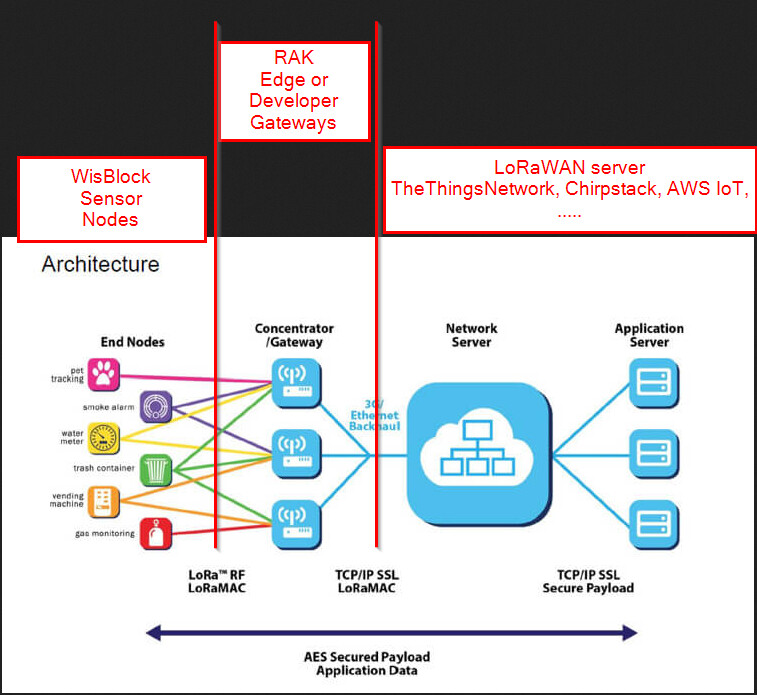
For your application, you can do this by using LoRa P2P, but not using LoRaWAN. LoRaWAN requires multi channel gateways and a LoRaWAN server.
But when using LoRa P2P you can setup one device as server node that can request data from multiple slave nodes.
Thank you for the clarification Sir @beegee . Actually, I already differentiated the difference between RAK4630 and RAK4631
For your application, you can do this by using LoRa P2P, but not using LoRaWAN. LoRaWAN requires multi channel gateways and a LoRaWAN server.
Ohh I see. I also tried the transmitter and receiver LoRaP2P codes from this github repo LoRa P2P and so far it worked. So, right know I’m looking for a sample documentation or forum discussion if someone already tried a multinode set up using RAK4630, and I cant seem to find any in the internet that I could pattern or get idea from.
By any chance, does RAK have sample Quick Start or Github repo for a multinode application? Sorry for asking since I’m not really expert in coding so I am just modifying and relying heavily in the codes available out there.
Thank you for this Sir @beegee. So just to clear everything up, is it not possible to use for example one RAK4631, to be a server node wherein it will be one who will request data from other RAK4631 who are set up as end node?
LoRaWAN depends on the use of multiple frequencies from the nodes to the gateway.
To do this, the gateway must be able to listen on at least 8 different frequencies at the same time.
A RAK4631 can only listen on one single frequency.
The gateway is build different, like our
Oww I see. Because I’m thinking if ever my set up is possible, only my “Server Node” is configured and connected to a LoRaWAN gateway to see the data sent by its different “End Nodes” on a “Network Server” such as TTN. So I guess, right now, it is not yet feasible and possible.
I’m not sure it ever will be, either, as that is exactly what the LoRaWAN gateway already does / was designed for.
In my opinion there would be no good business reason to put 8+ channels in an end node device board (PCB space, cost, power usage, radio interference), as that point you should just get/build a gateway.
LoRaWAN can be non-public and stay all local, or go to the cloud. There is really no reason to make a custom/proprietary concentrator (in my opinion) unless you are trying to work around/avoid a very specific limitation/issue in LoRaWAN, or if you are trying to make a proprietary solution you can commercialize [e.g. yolink].
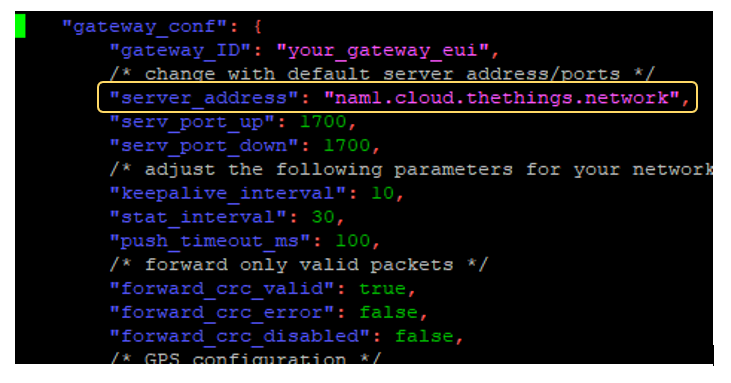
Do I just need to change the “server_address” with the server address of our server so that my gateway will forward the data directly to our server instead to the nam1.cloud?
Hello Sir @beegee I have another question, let’s say I already put the server address of our local server, can I see now the data from our server? The same thing/data that I usually see on TTN, when my gateway is connected to it?